


Directional Coupler -15dB


 payment on account
 In cash
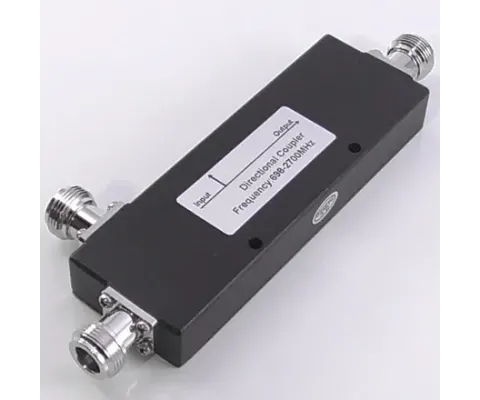
The Directional Coupler -15dB is a crucial component for precise control and distribution of radio frequency signals in various telecommunication systems. This passive high-frequency device is designed to tap off a fixed proportion of the input signal power from the main line, while allowing the majority of the signal to pass through with minimal loss. With a coupling level of 15 dB, it diverts approximately 3% of the total power, making it ideal for monitoring, test measurements, or feeding a signal to auxiliary equipment without significantly affecting the primary transmission.
The device operates across a broad frequency range from 800 to 2700 MHz, covering all major cellular bands (2G, 3G, 4G, and part of 5G), Wi-Fi, and other wireless systems. This makes it a versatile solution for Distributed Antenna Systems (DAS), in-building cellular signal enhancement, base station monitoring systems, and other professional RF applications. Its high-quality construction ensures low insertion loss (< 0.5 dB) on the input/output, which is critical for maintaining signal power and system efficiency. Excellent impedance matching (VSWR no worse than 1.5) minimizes reflections and maximizes power transfer.
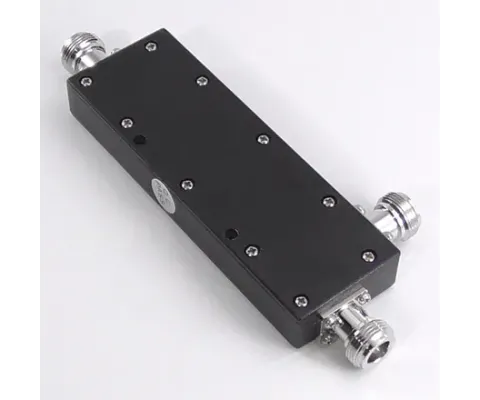
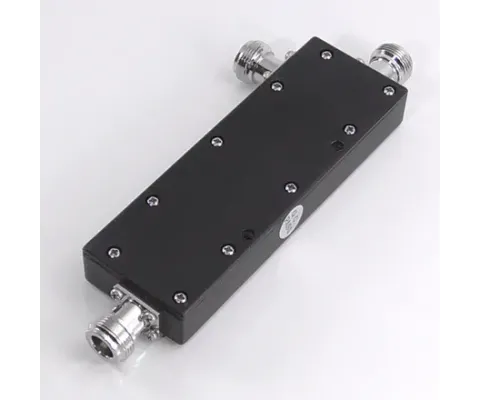
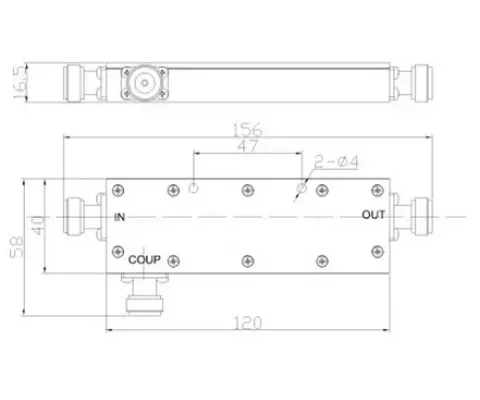
This directional coupler is aimed at wireless network installation professionals, telecommunications engineers, system integrators, and technicians working with mobile signal amplification and RF power distribution equipment. Using a coupler allows for efficient signal distribution to multiple indoor antennas, creation of test points within a system, or feeding a signal to a low-power repeater. Its compact dimensions (120x43x17 mm) and robust casing ensure easy installation and reliable operation, while standard N-female connectors guarantee compatibility with professional cable equipment. Support for up to 50 W of power and low internal intermodulation (IM3 < -150 dBc) confirm its high performance and reliability even in the most demanding conditions. Purchasing a directional coupler for your signal amplification system means ensuring its stability and manageability.
🎁 Expert Advice When installing the directional coupler, ensure that all N-female connectors are securely tightened to the recommended torque (use a torque wrench if available) and protected from moisture with electrical tape or heat shrink tubing. This will prevent signal loss and extend the device's lifespan.
💡 FAQ Question: What is the difference between a directional coupler and a splitter (power divider)? Answer: A splitter divides signal power evenly among all outputs, while a directional coupler taps off only a small portion of the signal with a specified coupling value, allowing the main power to continue down the line.
❓ Question: Can this coupler be used for Wi-Fi signals?
Answer: Yes, since the operating frequency range of 800-2700 MHz covers the primary Wi-Fi bands (2.4 GHz), it can be used for distributing or monitoring Wi-Fi signals.
❓ Question: What is the maximum cable length after the coupler?
Answer: The maximum cable length depends on its type (low-loss coaxial cable), signal frequency, and the acceptable losses in your system. Shorter cables generally result in less signal loss.
❓ Question: What type of connectors does this device use?
Answer: The device is equipped with standard N-female connectors, which are widely used in professional radio frequency systems.
❓ Question: Is a directional coupler necessary for a simple cellular signal booster system?
Answer: For the simplest system with a single indoor antenna, a coupler might not always be needed. However, if multiple indoor antennas need to be connected, signal monitoring is required, or a complex DAS is being built, a directional coupler becomes an indispensable component.
There are no reviews for this product, be the first to leave your review.
No questions about this product, be the first and ask your question.