
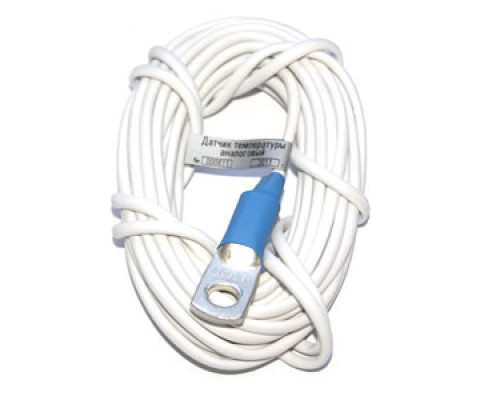

Analog Temperature Sensor


 payment on account
 In cash
An analog temperature sensor is an indispensable component for the effective control and regulation of temperature conditions in various systems. It converts the physical quantity – temperature – into a proportional electrical signal (voltage or resistance), allowing for highly accurate monitoring of changes and prompt response. This is a key component for automating processes where continuous and reliable temperature monitoring is essential.
The operating principle of an analog temperature sensor is based on the change in the electrical properties of a sensitive element due to temperature. Most commonly, thermistors (NTC or PTC) or Platinum Resistance Temperature Detectors (RTDs) are used, which provide stable and repeatable readings. Their advantage lies in their simplicity of integration and durability, making them ideal for systems requiring continuous control. Buying a temperature sensor of this type is a smart investment for long-term operation.
This solution is aimed at a wide range of users: from private homeowners looking to optimize their heating and hot water supply systems, to building automation specialists and industrial facility managers. An analog water temperature sensor or air temperature sensor will function effectively in smart home systems, boiler rooms, ventilation systems, pipelines, and other applications where precise temperature control is needed. It helps prevent overheating, optimize energy consumption, and maintain desired climate parameters. Temperature sensor installation is straightforward and does not require complex equipment.
The characteristics of such a sensor include high measurement accuracy, a wide operating temperature range (depending on the model), resistance to external influences, and easy connection to controllers and management systems. These precise temperature sensors ensure stable operation even in aggressive environments, which is crucial for the longevity of the entire system.
🎁 Expert Advice For the most accurate readings from an analog temperature sensor, install it in locations where a representative and uniform temperature of the measured medium is expected, avoiding direct drafts or sources of heat/cold that could distort the data. Ensure a watertight connection, especially when installing in a liquid environment.
💡 FAQ Question: What is the main difference between an analog and a digital sensor? Answer: An analog sensor outputs a continuous electrical signal proportional to temperature, requiring additional processing. A digital sensor converts temperature into a digital code, which is immediately ready for use by a microcontroller, often with higher accuracy and noise immunity over longer distances.
❓ Question: Where are analog temperature sensors most commonly used?
Answer: They are widely utilized in heating, ventilation, and air conditioning (HVAC) systems, for monitoring water temperature in boilers and pipelines, in industrial processes, and in smart home systems for climate control.
❓ Question: Is calibration required for an analog temperature sensor?
Answer: Most modern analog sensors come pre-calibrated. However, for critically important applications or after prolonged use, periodic verification and, if necessary, calibration may be required to ensure maximum accuracy.
❓ Question: How do I choose the right analog temperature sensor?
Answer: The choice depends on the desired temperature range, required accuracy, the type of medium to be measured (air, water, solid surfaces), operating conditions (humidity, aggressive environments), and compatibility with your control system.
❓ Question: Is an analog temperature sensor compatible with all controllers?
Answer: Most analog sensors output standard signals (e.g., 0-10V, 4-20mA, resistance change), making them compatible with a wide range of controllers that have appropriate analog inputs. It's crucial to ensure that the controller's input impedance or voltage range matches the sensor's output characteristics.
There are no reviews for this product, be the first to leave your review.
No questions about this product, be the first and ask your question.