Anyone who encounters the problem of the disappearance of the GSM signal, "gurgling" when talking on a mobile phone comes to the decision that it is necessary to somehow correct the situation. In our time, it has become a good tradition to open Google, ask questions and choose offers on your issue. And here the most difficult part begins - a million offers, each seller tries to impose his best equipment.
This statistic is taken in general for Ukraine. If we consider in particular cities:
- GSM-900 / LTE-900 - is used mainly along highways, in rural and mountainous areas, as well as in forest areas. 2G and 4G networks work.
- GSM-1800 / LTE-1800 - is used in cities with a population of over 50 thousand people (regional centers, district centers). 2G and 4G networks work.
- WCDMA-2100 – in this range, a 3G network operates, which is eventually upgraded to a 4G network. The approximate coverage from the base station is 5-8 km.
- LTE 2600 – is used exclusively in places with a large number of subscribers, has a very limited coverage area, which is several km from the operator tower. The 4G network operates.
Three "whales" that you need to consider when choosing a GSM amplifier.
a) Cellular communication standard.
 Operators Vodafone, Kyivstar, lifecell operate in the frequency range 900, 1800, 2100 and 2600 MHz. Here are some approximate statistics on the frequencies of operators:
- Kyivstar — approximately 60% GSM-900 / LTE900 standard and 40% GSM-1800 / LTE1800
- Vodafone — approximately 35% GSM-900 / LTE-900 standard and 65% GSM-1800 / LTE-1800
- lifecell — approximately 25% GSM-900 / LTE-900 standard and 75% GSM-1800 / LTE-1800
This statistic is taken for Ukraine as a whole. If we consider cities in particular:
- GSM-1800 / 4G LTE1800 – used in cities with a population of over 50+ thousand people (regional centers, district centers);
- GSM-900 / 4G LTE900 – used mainly along highways, in rural and mountainous areas, as well as in forest areas.
What caused this distribution?
- The 2G GSM-900 / 4G LTE 900 mobile communication standard has the largest coverage radius (up to 35 km from the operator's base station), the signal is better reflected from buildings, terrain. Accordingly, it is used in places to provide a signal to large areas using one base station.
- The 2G GSM-1800 / 4G LTE 1800 cellular communication standard is used to increase the number of subscribers served. Compared to the 900 MHz network, it allows you to serve two or more times more subscribers from one operator's base station. But the disadvantages include working in a small area.
- The 3G WCDMA-2100 cellular network standard works in many places and regardless of whether it is a large city or a large sparsely populated area. Over time, operators will change the network to 4G, which will operate in the 2100 MHz frequency range.
- 4G LTE-2600 communication standard exclusively in large cities.
How to determine the mobile communication standard? Detailed description of the measurement method.
b) Mobile signal gain.
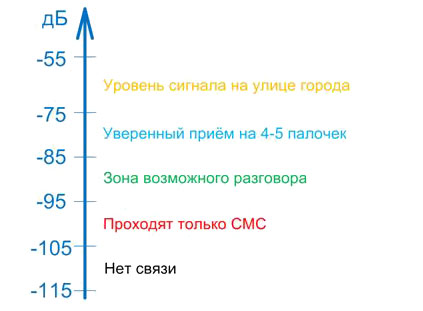
 This parameter plays a big role in the operation of the repeater. The gain is the ability of the repeater to receive a signal, separate the useful signal from the noise and “raise” it to the required level. The higher the value of this parameter, the better. When the signal level from the operator is weak (1-2 divisions or absent on the mobile phone at the place of installation of the receiving antenna), then you need to select a more powerful repeater - at least 75-85 dB. If the signal level at the place of installation of the receiving antenna is 3-5 divisions, then you can select amplifiers with a gain of 55-65 dB.
c) Repeater output power.
 The power of the repeater is directly related to the coverage area of the GSM signal. For example, if you need to amplify the 2G/4G signal in a room with an area of up to 70 sq.m, then models with a power of 5-10 mW are suitable. In a room with an area of 150 sq.m. you need at least 10-50 mW. Accordingly, for areas of 400, 700 squares, 150 mW (20 dBm) and 500 mW (27 dBm) are already needed.
How do I determine the number of internal antennas I need to install?
Mobile repeaters, which are used by subscribers to amplify a weak signal, are low-power receivers. Accordingly, to amplify the 2G / 3G / 4G signal throughout the room, it is necessary to select the number of service antennas, as well as place them correctly.
Example of shielding properties of rooms:
| Construction type | The amount of attenuation | Note |
| Wooden log cabin | ≤ 10 дБ | Dry wood |
| Brick wall in 1.5 bricks | ~ 30 дБ | Without reinforcing mesh |
| Brick wall in 2 bricks | ~ 35 дБ | Without reinforcing mesh |
| Reinforced concrete wall (panel) | 35…50 дБ | Depends on wall thickness and reinforcement density |
| Reinforced concrete floor | ≥ 40 дБ | Depends on the fittings |
| Solid metal roof covering | 60…90 дБ | Depends on the condition and quality of the seams |
| Metal mesh measuring 3×3 meters with a cell size of 3×3 cm | 20…40 дБ | Depends on location relative to the antenna |
These shielding properties also apply to the placement of the receiving (external) antenna. When installing it, it should be as far apart as possible from the service (internal) antenna. As for the insufficient separation of these antennas, the GSM amplifier will amplify itself, i.e. the amplified signal from the service (internal) antenna will reach the receiving (external) antenna, thus, the useful signal from the communication operator will not be able to amplify, i.e. it will work on itself.
Indoor gsm antennas are usually installed in rooms where it is necessary to provide a stable and high-quality signal. One gsm antenna covers an area of 70 to 150 square meters, provided that it is one whole room, or something with a common open corridor, or with plasterboard/glass partitions. An important role in the coverage area is played by the power of the 2G / 3G / 4G repeater, which is an integral part of the entire mobile communication amplification system.
Conventional scale of signal levels in dB and divisions on mobile phones: