
Online, you'll find hundreds of different offers for mobile signal amplification. As with any product, there are cheaper options from unknown manufacturers and better ones, typically from reputable brands. We understand how difficult it is to choose equipment, especially when you are not a technical specialist. We strongly recommend reading this article.
Currently, in the market, GSM repeaters for domestic use are available from manufacturers like Eurolink (Poland), Picocell (Russia), Andrew (Germany), HiTech (China), as well as so-called manufacturers under names such as RF, R.Cell, Verstarker, Anytone, and Lintratek. We can definitively say that these latter four brands have a low level of quality and do not always successfully solve the problem of mobile signal amplification. Why?
We specifically conducted an independent experiment in our laboratory. The study involved an RF-980 repeater (China) and a Eurolink D-5 repeater (Poland).
RF-980 Repeater (China) in Action
Eurolink D-5 Repeater (Poland)
The video clearly shows how the signal level on the RF-980 constantly drops. What does this look like in practice? Your mobile phone doesn't change the number of signal bars immediately, so you won't see them disappear and reappear. However, during a call, you'll hear the connection "gurgle" or cut off, and you'll frequently receive "missed call" SMS messages. The Eurolink D-5 repeater, on the other hand, showed a stable signal level. In practice, you will receive a high-quality, stable connection.
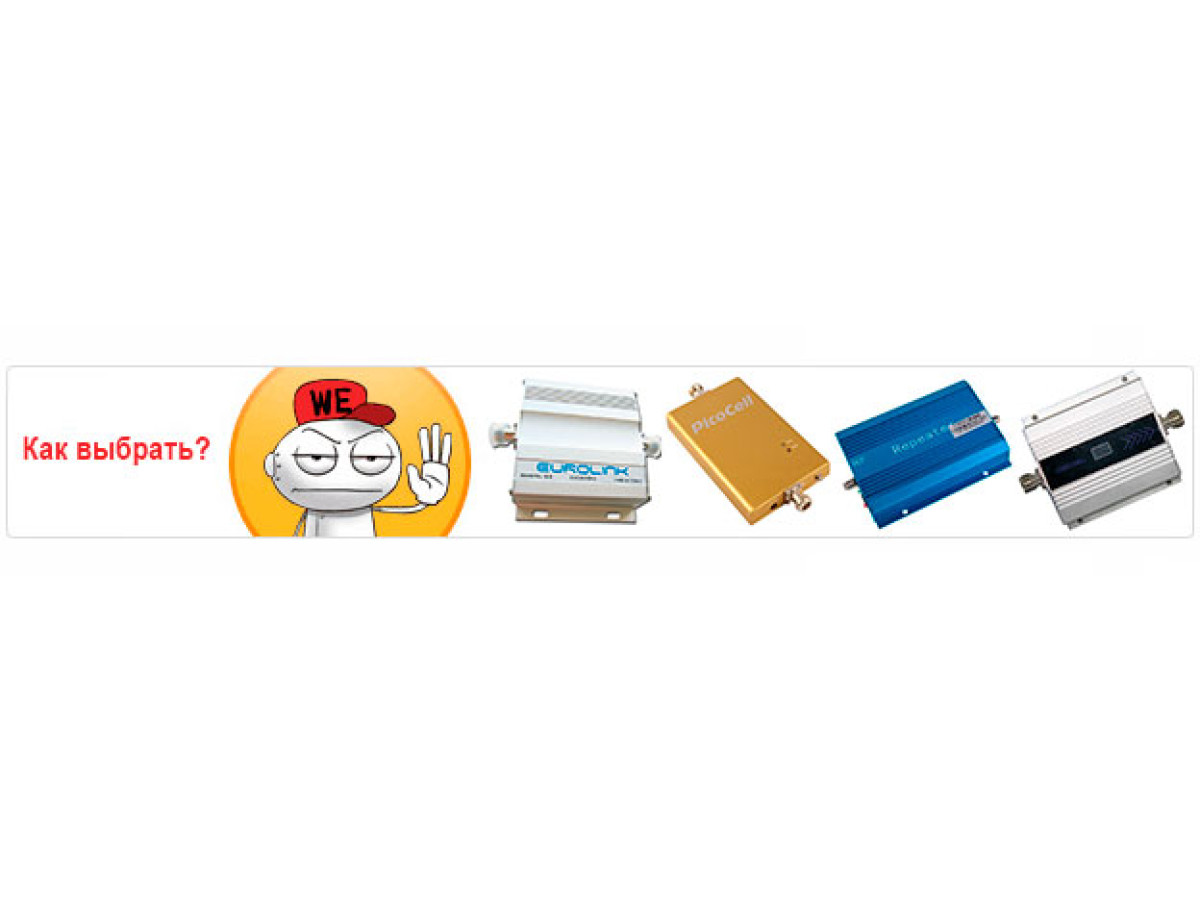
Below are photos of models we strongly advise against using.


Our service center frequently receives these repeater models. Of them, 80% arrive new, having failed within fifteen days of use. Our technical capabilities allow for almost any repair work. However, experience shows that the repair cost is often so high that buying a new repeater becomes more economical. Therefore, we provide a list of models that absolutely do not meet their claimed technical specifications and, by definition, cannot adequately amplify mobile communication. You can see for yourself: if you manage to achieve a good result with one of these, we are willing to buy it from you at double the price!
Which models are worth considering?
First and foremost, we want to highlight the manufacturer Andrew. All equipment is produced in Germany. Andrew GSM repeaters are of very high quality and reliable in operation. However, their cost starts from 700 Euros. Consequently, not everyone can afford to install Andrew GSM repeaters.
In the price-to-quality category, two manufacturers stand out: Eurolink (Poland) and Picocell (Russia). All their models fully comply with their declared technical specifications, effectively amplify the mobile signal, and we are unaware of any complaints regarding their operational quality.
Summary: repeaters from Eurolink and Picocell brands are the most affordable and offer good quality.
The second important point is the quality of passive equipment: antennas, cables, and connectors.
All, absolutely all GSM repeaters have an impedance of 50 Ohms, so using ordinary television cable or CCTV cable is completely unsuitable!
Why? For at least two reasons:
- Using a coaxial cable with a 75 Ohm impedance risks damaging the mobile signal repeater.
- Television cable is designed to work at frequencies up to 700 MHz. At 900 MHz, signal loss over 100 meters is more than 40 dB. If used at 1800 MHz, losses will exceed 75 dB/100 meters. Adding losses in adapters and connectors, you can expect an additional loss of at least 4 dB for each.
Thus, using a cable just 10 meters long at 900 MHz can result in losses of more than 10 dB, and the impedance mismatch will increase the VSWR (Voltage Standing Wave Ratio) to more than 2.5. Ultimately, the useful signal will remain in the cable, the repeater will heat up more, and due to the impedance mismatch of the cable, the GSM repeater will 100% fail.
Regarding antennas: Some of our customers, seeing an external Yagi-type antenna, want to save money and use their TV antenna. Outwardly, they look similar, but their operating frequencies are entirely different. You can conduct an experiment: connect an iron to your TV instead of an antenna – did you get anything? It's the same as connecting a TV antenna to a repeater designed for the 900 MHz standard instead of a proper GSM antenna.
 We have tried our best to describe how these systems work and what to pay attention to. Now, the choice is yours!